
Creating Healthy & Active Places
Physical and social environments are important elements in people’s lives and can impact on their health and wellbeing. Neighbourhoods which can increase human Connectedness through their design and where there is access to good quality greenspace, safe streets and places for children to play outdoors can positively benefit health.
By increasing physical activity levels, this can lead to increased life expectancy and decreased health inequalities. This can provide substantial health benefits for individuals and significantly reduce the risk of diseases such as cancer, diabetes and dementia
Creating places which are Accessible, Beautiful and well-Connected encourages people to walk, cycle and children to play becoming more active and in turn healthier.
Blackwood aims to take advantage of the health benefits related to physical activity and so it is vital to create Beautiful, Accessible places that put pedestrians first and make it safe and attractive for younger and older people to go outdoors.
It is important that we see place as an asset which, if properly designed and managed, can create the conditions for people’s health and wellbeing to flourish.
Design Principles
A healthy development should take into consideration the following principles:
- Climate change: Reducing dependency on fossil fuels, utilising sustainable construction materials, orientation, tree shading, utilising EV charging, promoting walking/cycling
- Thriving and accessible natural environments: Natural environments, open spaces, biodiversity and wildlife are restored, enhanced, preserved, protected and Accessible for all; good air quality, good water quality and Affordable resources, and safe levels of noise; reduction on carbon emissions for new and proposed development. Healthy food, promoting opportunities for growing local produce, provide ample garden space, enabling leisure and physical activity
- Air quality: promoting sustainable transport and measure to promote improved air quality
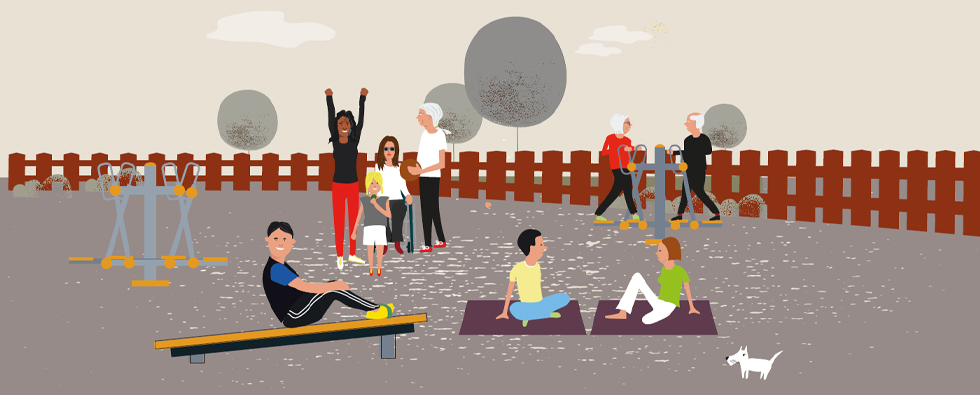
- Social cohesion and participation: There is a socially cohesive and Connected community; there is diversity; the community is safe and secure; there are spaces for community gathering and interaction; the colocation of local services and facilities with walking and cycling routes; there are minimal health inequalities; increased health equity and support for mental health. Outdoor gyms.
- Prosperous and sustainable economy: access to public services, enhancing viability of town centres
- Quality housing development and Beautiful design: good quality, affordable housing, built to meet needs of changing population, sustainable principles embedded in design, mixed tenure housing, reducing social isolation, recognising the importance of trees and landscaping, shared surface streets, meeting of exceeding space standards,
- Neighbourhood and community spaces: improving access to health care and education, clearly defined public space and amenity space, providing community space, creating safe, inclusive Accessible environments, promoting diversity. There is affordable access to quality public climate resilient infrastructure; Connected neighbourhood and community spaces, education, childcare, public health, health and social care, recreation facilities, Affordable access to healthy food through community shops and allotment schemes.
- Movement and access: promoting active travel, increase physical activity, restricting vehicle access, improve public transport, improving wider connectivity