
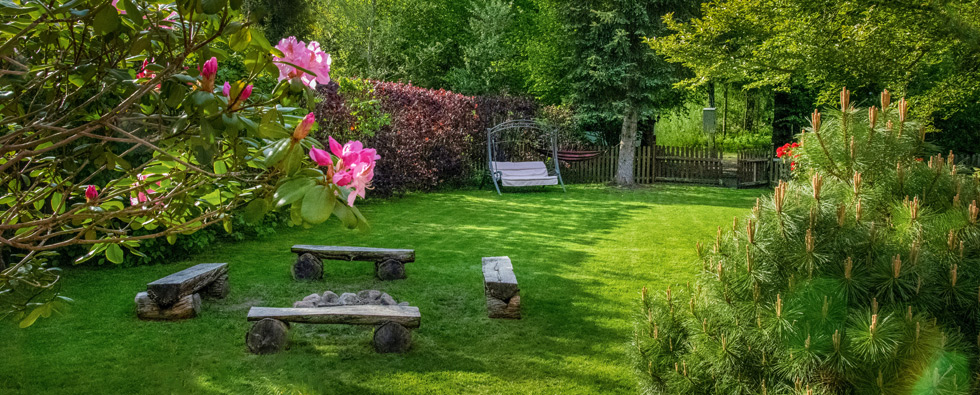
Gardens
Private and communal gardens provide much needed private/public outdoor space as well as improving social interaction and metal wellbeing. Studies have shown that being in and experiencing Beautiful, good quality outdoor space can reduce depression and anxiety as well as maintain independence and prevent cognitive decline.
Private and communal gardens should be designed for use by residents for a range of functions, including space for play, seating, food growing, tree planting, drying laundry, and social interaction. Raised planting beds are also of benefit for wheelchair users and those with limited mobility to allow them to fully experience and enjoy the garden space offered.
Private gardens should also be Accessible and adaptable. To help meet the changing needs of residents, it is beneficial for there to be sufficient space in gardens for houses to be extended while retaining reasonably sized gardens. Changes to existing houses can come in various forms including alterations, extensions, development of additional buildings within the garden ground e.g., sheds, garages, fences and walls.
Sunlight is an important feature of gardens and open spaces. Each of these spaces will have different sunlight requirements however half the area of gardens or amenity spaces should be capable of receiving potential sunlight for more than two hours during the spring equinox.
In higher density situations it may be appropriate to reduce minimum private garden sizes provided a private, sitting-out area for each house can be achieved, un-overlooked by any window either at ground or first-floor. The loss of sunlight in such situations may be an acceptable price to pay for a tighter urban format or closer proximity to central facilities for example.
Sufficient garden provision should be implemented to ensure that the space accommodates most activities and is at the same time creating a Beautiful space to offer visual delight, receive some sunshine, and encourage plant growth.
Front gardens are fundamentally different to rear gardens. The most important issue should be the quality of the overall development in terms of its design and layout. Front gardens can often create interesting streetscapes and can help to provide developments with a sense of enclosure enforcing people’s privacy. Front gardens should be Beautiful and well designed and of a size that discourages use as car parking spaces.
In addition, balconies may provide outdoor amenity space in closer proximity to an upper storey dwelling. In an urban situation on sites of less than 0.1h such a balcony or terrace would be acceptable as the only outdoor amenity space for a flat. Care must be taken to limit overlooking of nearby private gardens and sitting out areas from balconies or terraces.
Local authorities may have different minimum garden sizes and consultation should be sought with each relevant District Council Planning Department.
Design Principles for Houses
- For 3 or more bedroomed houses, a minimum private (i.e. rear) garden size of 120m2 for most types of houses is recommended
- Rear gardens should try and be at least 9m in depth if possible.
- Front gardens should generally be between 2-4 meters in depth
- Gardens should be screened by above-eye-level walls or hedges, typically a minimum of 1.8m in height.
- Gardens must contain a good sized hardstanding area for sitting out that receives sunshine during at least part of the day.
- Provision for cloths drying space or a rotary dryer
- Raised planter beds provided to ensure inclusive garden design
- Private garden spaces should avoid any sudden changes or steps in level to provide a fully inclusive and Accessible experience.
Design Principles for Flats
- For two or more bedroomed flats communal residents’ gardens should be provided based on a minimum area of 25m2 per flat.
- Front gardens should generally be between 2-4 meters in depth
- Gardens should be screened by above-eye-level walls or hedges, typically a minimum of 1.8m in height.
- Gardens must contain a good sized hardstanding area for sitting out that receives sunshine during at least part of the day.
- A balcony or terrace over 5m2 in extent will count towards the total garden provision for flats.
- Provision for cloths drying space or rotary dryers
- Raised planter beds provided to ensure inclusive garden design
- Private garden spaces should avoid any sudden changes or steps in level to provide a fully inclusive and Accessible experience.
Refuse Collection
It is recommended to provide a shared bin-collection point screened by an above-eye-level wall. This should be located within 25m of an adopted road.
Refuse collection points should be Accessible to people of all ages and across a range of physical and mental abilities. Such facilities should also be clearly identifiable, particularly for the partially sighted, blind and those with dementia. Refuse collection points should also be well designed and Beautiful to blend in with the surrounding area and strengthening the visual amenity of the area.
Progressive refuse disposal systems should be considered wherever possible. Other refuse systems that reduce the visual and practical impact of large numbers of bins include large-capacity standalone in-ground waste stores shared by streets or neighbourhoods. These stores can be mounted, lifted and emptied by refuse-collection vehicles. Again, such infrastructure should be considered at an early stage to ensure an Affordable and efficient strategy is in place to avoid the need to retrofit with its ensuing disruption and detrimental impact on the streetscape.
Design Principles
- Surface waste collection and storage infrastructure minimised on all new developments. The delivery of underground waste storage systems with surface collection chutes are desirable.
- Bins are safely Accessible and the collection system is operationally viable, taking into account swept path analysis, walking and pulling distances, slopes, vehicle sizes, access to bin stores, interactions with pedestrians, etc.;
- The waste management strategy is compliant with the designated Council’s policies and the requirement of Scottish legislation so that provision is made for the full range of recycling services and that these are fully integrated into the collection system (e.g. that each bin store has sufficient space to accommodate the full range of bins);