
Placemaking
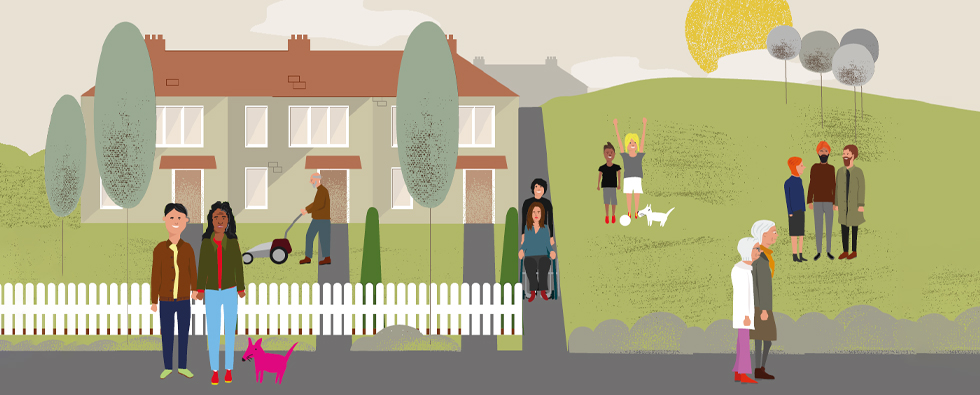
Utilising the principles of placemaking, Blackwoods vision is to rethink and evolve public spaces to strengthen the relationship between people and the spaces around them. We see public space as an interface between our private and public lives so we seek to promote fully Accessible environments that enrich lives and the community.
To achieve the best outcome, we look to understand and utilise the existing characteristics of different places and how they work. We strive to create variety and make enjoyable, Beautiful, vibrant spaces for everyone promoting a diverse range of activities ranging from sitting down, meeting people, a place to read and play areas being just a few examples.
At Blackwood we are keen to promote these ideals using a collaborative process creating a better more Connected neighbourhood through co-design and co-production to produce successful outcomes resulting in effective healthy placemaking.
Qualities of Successful Places
The six qualities of successful places as identified within “Creating Places: A policy statement on architecture and place for Scotland“ are set out as:
- Distinctive – To support the identity of the place, spaces should be distinctive in their design and reflect their location, history and/or culture. The unique features and opportunities of a location should be utilised to create distinctive, Beautiful and usable green infrastructure that enhances sense of place.
- Safe and pleasant – Streets and public spaces are well defined, safe and inclusive for all people with different physical abilities, ages or backgrounds. They are designed to be robust and adaptable as well as Connected to promote opportunities for social interaction and a range of activities while reducing crime and anti-social behaviour.
- Easy to move around – Walking, cycling and public transport are prioritised to provide a choice of transport modes and avoid dependence on private vehicles. Well designed, Accessible and safe active travel routes connect to the wider active travel and public transport network, and public transport stations and stops are positively integrated.
- Welcoming – Welcoming places are open, pleasant and well connected, this can help people find their way around a place, new district or development. Design should make it easy for people to navigate as well as using built and natural features into a place to make it more welcoming
- Adaptable – Adaptable homes and public spaces with space to allow the opportunity to expand and flexibility are important in the context of changing working and living patterns. Having the opportunity to stay in a property or neighbourhood that can adapt rather than need to move can help to create a stronger community
- Resource efficient – Providing Affordable and efficient use of resources/materials should be encouraged to reduce environmental impact and carbon footprint. Resource efficiency and making best use of what the site offers should be sincerely thought about as well as local materials and labour.
These guiding principles continue to underpin the Scottish Government’s approach to delivering good places and therefore Blackwood strive to achieve these principles going forward.
The Value of Good Buildings and Places
Good buildings and places can have personal value and meaning to us as individuals. They give us a sense of belonging, a sense of identity, a sense of community, and offer us the amenities to meet our needs.
Good buildings and places can provide value, attract talent and investment and are the essential infrastructure which sustains business. Good places can be the crucial component in defining whether we choose to walk or drive, whether our lifestyles is active and healthy, and the size of our carbon footprint.
People and Communities
Quality places are often central to community life. A successful place is Accessible to all and encourages people to be Connected with each another. The connections which are nurtured help to create communities with high levels of positive activity and interaction. These are communities which are safe, desirable, socially stable and resilient.
Green Infrastructure
Green infrastructure brings our towns, cities and communities alive and makes them great places to live in. It is a term used for vegetated areas such as parks, trees, woodland areas and green roofs, that deliver a wide range of benefits for people and nature. Green infrastructure also helps in reducing carbon emissions and are a considerable impetus for healthier lifestyle choices.
Green infrastructure can provide multiple functions and benefits in the same space. These functions can be environmental (including conserving biodiversity or adapting to climate change), social (such as encouraging active travel or public parks), and economic (through attracting businesses and raising property prices).
Green infrastructure also allows us to benefit more from nature by providing opportunities for recreation, outdoor play and learning.
For more information, please refer to the “Nature” section of this guide.