
Bicycles
High quality cycle parking, including secure storage, is essential in making cycling as attractive as possible and promoting a good form of exercise and activity.
Increasing the use of cycles can reduce traffic congestion and pollution, and all developments must be designed to encourage cycle ownership and use. It is important that the appropriate infrastructure is embedded from the start
For new developments, cycle parking should ideally be integral to the buildings to avoid visual clutter in the public realm and encroachment of green open space. Secure indoor storage for bikes should be provided in accordance with the number of flats being provided. Conversions may require a more flexible and creative approach to cycle storage.
Where it is not possible to provide adequate cycle parking within residential dwellings, practical cycle storage should be included on street and within garden provision.
Cycle storage should take consideration of its context and be designed to integrate into the development in terms of location and materials. Material choice should ensure the cycle store is not only secure but also Beautiful and fits with the development and surrounding landscape.
Secure cycle stands can also be utilised in public areas and should be designed to integrate with the surrounding context.
In appropriate areas, where density and local population is sufficiently high to ensure their use, cycle-hire stations and docks should be encouraged and provided at key local areas.
Design Principles
- Cycle parking and charging facilities integrated into the design of the building or landscape
- Storage space for at least 1 bicycle per flat and 2 bicycles per house
- Routes and paths Connected to the wider neighbourhood & community
- Cycle storage that is safe, prominent, secure, covered, and close to home and of a material that integrates within the surrounding context
- Secure cycle stands in public areas to be approx. 750mm high, 700mm long and spaced 1m apart.
- Opportunity for cycle-hire stations, community hubs, bike-share schemes etc.
- Embrace new cycle technology.
Electric Cars
Provision for electric charging points, which can be used by cars, motorcycles, bicycles and mobility aids, should be provided for all proposed on-plot car parking spaces within new developments.
In larger car park settings, such as parking courts, car parks or unallocated street parking, infrastructure should be put in place (via underground ducting) to be Connected to an electric charging point in future.
The level of provision of electric charging points should be appropriate to the development size and type, its level of parking provision and its context and location. In the case of car parks, upstanding or inset charging points can be integrated into the design, whereas more innovation may be required for on-street charging points – which should be integrated into street lighting columns or other smart street furniture items to reduce street clutter.
Designs should strive for flexibility in the face of technology-driven changes to the way we use cars. Wherever possible, designs should be adaptable, allowing for features such as new charging technologies or the conversion of parking areas to green space.
To ensure that the infrastructure required by the growing number of electric vehicles users is delivered, one of every six spaces should include a fully Connected and ready to use electric vehicle charging point, in developments where ten or more car parking spaces are proposed. Electric vehicle parking spaces should be counted as part of the overall car parking provision and not in addition to it.
Design Principles
- Minimum of 1 EV charging point for individual dwellings.
- For buildings comprising of more than 1 dwelling, a single EV charging socket should be provided per dwelling, subject to the following;
- An EV charge point need not be installed to car parking spaces located within a covered car park.
- The total number of spaces with access to a charge socket should be the lower of the total number of dwellings or the total number of parking spaces provided.
- Where there are more parking spaces than dwellings, any accessible parking spaces not already provided with access to an electric vehicle charge point socket should be provided to at least one in every four spaces.
- Consider innovative EV charging point design to minimise impact on the overall design and cost.
- Fast charging provision required for residential developments, non- residential developments, rapid charging will be required.
- To meet increasing future demand for charging points, provision for infrastructure enabling future installation should also be considered in developments where charging points are being provided.
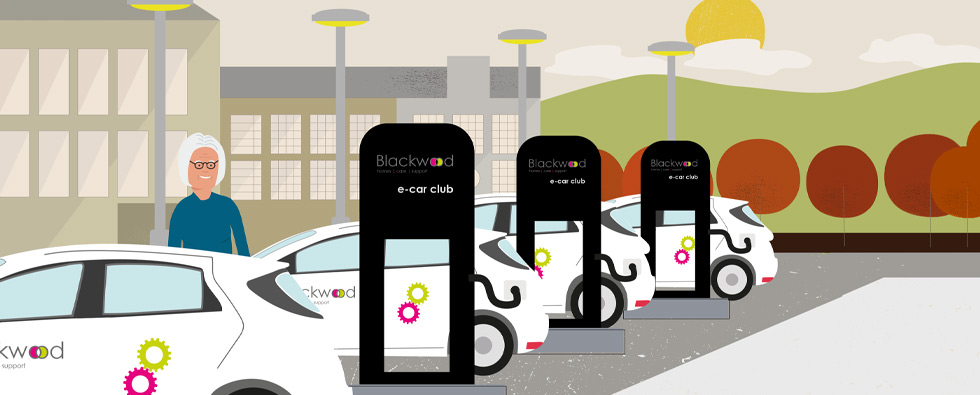
Car-sharing and Car Clubs
Car-sharing schemes can be introduced into new developments as part of a package of measures (including safe and attractive streets, good lighting and convenient cycle storage) designed to give residents and employees a realistic and attractive alternative to owning a car while also offering an Affordable & sustainable alternative to car ownership. Ideally, the car-share vehicles themselves should be low-emission, electric or dual-fuel hybrid models.
Car clubs offer a pay-as-you-drive rental arrangement. This is particularly suitable within compact mixed-use developments where there is likely to be a sufficient market to make such a scheme commercially attractive
Developments should be designed to facilitate car clubs either now or in the future. They should also be responsive to changes in local car-driving and car-ownership dynamics, offering the opportunity to change on-street parking spaces to car-club spaces with ease and without detriment to the streetscape.
Parking
Parking should provide an inclusive approach to design to ensure that buildings are as Accessible to as wide a range of people as possible. Solutions should be integral to the design and layout of new developments to ensure the best outcome is achieved.
In all new developments, car parking should be designed to have a minimal visual impact on the site and surrounding area. External car parking should be enhanced by a structure of tree and hedge planting arranged both within the parking area and along its boundaries.
As well as providing an appropriate level of car parking, it is important that new or extended developments incorporate good design for the layout, landscaping and lighting of parking. This should be user-friendly and should not interfere with the public highway or access adjacent to the parking area
Private parking to houses should be contained within the curtilage of the dwelling with a person able to exit from a vehicle directly onto a firm surface of an Accessible route to the dwelling entrance.
Communal parking areas should be divided and distributed around the layout, with some spaces convenient for visitors on or near the frontage, and others at the side or rear of dwellings. Again, in all cases care should be taken that communal parking areas are overlooked by the kitchen or living-room windows of at least some dwellings, or else by footways in regular use, in order to discourage car-related crime.
Parking spaces between structures may require an increased area for pedestrian movement around the vehicle.
Parking spaces capable of use by disabled to the indicated size standards noted below. Accessible spaces are to be level with drop kerb access where required to ensure inclusive design throughout. Accessible spaces can be adjacent to an area on the same level, such as a lowered footway of sufficient width for getting in and out of vehicles. Scottish building technical standards recommend a ratio of 1 space per 20 proposed for an Accessible space. Blackwood is aiming to achieve at least 10% of all proposed parking spaces (with an absolute minimum of one space) in each parking court, suitable for use by disabled people.
All parking should be designed to be fully Accessible by all to ensure inclusive design is at the forefront for new developments to cater for all needs both now and in the future.
Fences should not be used to enclose parking courts as they are vulnerable to vehicle impact. Walls or a metal barrier should be used where possible to provide a robust solution to parking areas while being designed to maintain the aesthetic of the design and integrate with the overall context.
Design Principles
- For houses, car parking should be located within the curtilage of each house. All tenures should have a minimum of 1 space. Private houses with at least 3 bedrooms should have at least 2 spaces
- For flats, all car parking should be located within the curtilage of the property. A minimum of 150% car parking should be provided with at least 1 space dedicated to each flat.
- The preferred size of a parking space is 5m x 2.5m.
- The preferred size of an Accessible space is 5m x 2.5m with an additional minimum delineated 1.2m space either side and at the rear.
- For on street parallel parking, spaces should be 6m x 2m where adjoining a footway or 6m x 2.4m where no footway is provided. They should be increased to 6.6m x 3.6m for Accessible spaces.
- Parking spaces opposite each other should be separated by at least 6m to allow manoeuvring in and out.
- Parking spaces should be no greater than 30m from the entrance door for old and ambulant disabled users. For wheelchair users a distance of 15m is preferred.
- The ends of parking spaces should be protected by a wall or physical barrier approx. 600mm high or kerbs set 600mm into the parking space.
- 10% of all proposed parking spaces (with an absolute minimum of one space) in each parking court, should be provided suitable for use by disabled people.
- Parking spaces should have little or no crossfalls.
- Accessible spaces marked with international symbol of access
- Level access routes or drop kerb access required between parking spaces and Accessible routes
- Utilise permeable surface materials for the parking spaces to promote sustainable drainage systems
- Use high quality, Beautiful and contrasting surface materials to delineate parking spaces and Accessible spaces /routes
- External car parking should be enhanced by a structure of tree and hedge planting arranged both within the parking area and along its boundaries.