
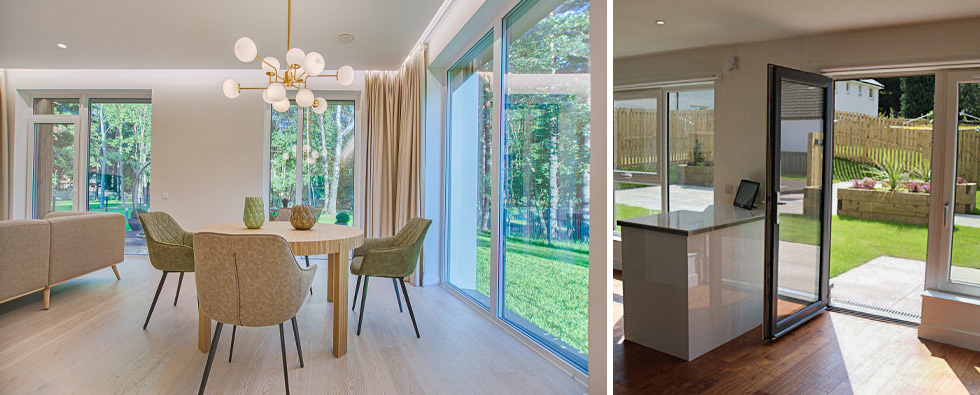
Windows & Doors
Windows & doors should harmonise with the scale, size and form of the proposed building but also and more importantly, neighbouring buildings. Windows should be of a size to ensure good levels of daylight can penetrate into the building creating Beautiful spaces that promotes mental health and wellbeing. Low level window cills contribute to this aspect while also ensuring wheelchair users benefit from clear, unobstructed views.
If buildings are designed to be facing one another, it is advisable to try and set out windows to avoid direct views into other dwellings. Windows should be designed and placed to allow privacy for the occupant and provide a sense of security by overlooking streets and open spaces.
It is important that windows are made of suitable, durable and Affordable materials with good thermal and sound insulation properties. Windows must be capable of resisting the weather, be easy to clean and provide safety and security for the user. Large French doors, sliding doors or bifold doors must also adhere to the above and are encouraged to ensure the user is Connected to outdoor spaces while improving natural daylighting.
Many people have difficulty opening and closing windows. Windows should be positioned and designed to allow for people of various heights and different physical abilities. Windows should have easy to operate controls for opening windows and cleaning allow users full control over their home.
Main entrance doors must allow easy and convenient passage to and from the dwelling and provide good security. Doors are encouraged to be Accessible, be step-free and must have a threshold that can be negotiated by someone in a wheelchair. Entrance doors must have a clear opening width that allows a wheelchair to pass through.
Internal doors must be positioned to assist easy circulation throughout the proposed design. Sliding Pockets doors are to be utilised for easy manoeuvring and circulation which also aid to avoid doors taking up space, awkward door swings and blocking wall switches. Research has shown that using sliding pocket doors give you more freedom to use all the space in your home by freeing up more than 8% ‘dead’ space in an average home.
Sliding pocket door systems hide discreetly within the existing walls removing the complex manoeuvring around swing doors and provide a Beautiful aesthetic solution to the home. Automated controls allow for easy, simple control of door opening and locking and aid those of limited mobility to move freely around the home without obstruction.
Design Principles
- Window cill height should be no greater than 600mm from the floor.
- Fixed safety glazing required up to between 800-1100mm from floor level depending on storey height in line with current building regulations.
- Window controls should be operable with one hand and be at a maximum of 1200mm from floor level – if this can’t be met a remote control system will be required.
- All handles and controls should be of a design that is easily grasped, adjusted, and operated
- Tilt and turn or pivot window systems for controlled ventilation, be easily Accessible and allow easy customer cleaning.
- Slim window frames with Beautiful contemporary finishes throughout
- External entrance doors must have a minimum clear opening width of 840mm
- Recessed doormats are encouraged and should extend 2 metres to catch the full circumference of most chair wheel
- External door handles should be lever type, robust and easy to grasp and operate.
- External door handles should be at least 100mm in length and with a thickness or diameter of at least 25mm. External door handles should be set level with light switches at a height of 900 -1050mm from the floor.
- External doors should have colour to contrast with the door finish to help people with impaired sight.
- External doors should have a large format vision panel either integrated into the door or at the side. Door viewers can be utilised for private external entrance doors or main entrance doors to flats and should be set at a height of1200mm for use from a wheelchair.
- Sliding Pockets doors to be utilised for easy manoeuvring and circulation which also aid to avoid doors taking up space, awkward door swings and blocking wall switches
- Sliding pocket door protrudes 70mm from door frame and has recessed handles built into the pocket door for manual assisted control that also acts as a fail safe
- Automated linear motor for pocket sliding doors. The magnetic technology applied makes it very silent and easy to use with switch controls. Door speed can be customised to suit individual needs
- Electronic locking where required on doors for easy and efficient control over privacy
- Pocket Door clear opening of 840mm and be Accessible with clear level thresholds.
- Contrasting colours on the door and/or frame to provide a clear visual indicator for those hard of sight
- Any Internal hinged pass doors must be positioned with a clear space of at least 300mm adjacent to the handle edge on the pull side of the door and preferably on the push side as well.
- The clear opening width of any Internal hinged doors must be at least 800mm. A door giving a clear opening width of about 820mm should be encouraged.
- Hinged Doors should open to an angle greater than 90 degrees to give maximum clearance from the handle as a person passes through.
- Handles at any height between 750mm and 1050mm from the floor.
- Remote controlled automated blinds throughout for easy privacy and daylight control can be managed via handsets, wall switches or timers
- Automated blinds for simple and easy control over the privacy and daylight levels within the customer home.